Protecting Your Legacy: Understanding the Different Types of Life Insurance

Life is filled with responsibilities, dreams, and the desire to create a meaningful future for the people we love. Whether you're building wealth, raising a family, running a business, or planning for retirement, one question eventually becomes unavoidable:
What happens to the people and goals you care about if you're no longer here?
While no one enjoys thinking about worst-case scenarios, preparing for the unexpected is one of the most powerful acts of care and responsibility a person can make. That is where Life Insurance becomes more than a financial product—it becomes a strategy for protecting the future.
Many people think Life Insurance simply provides a payout after death. In reality, modern policies can serve multiple purposes: income replacement, wealth transfer, debt protection, estate planning, business continuity, and even long-term financial growth.
Yet despite its importance, many people remain confused about the different options available. Terms like term life, whole life, universal life, and cash value can quickly become overwhelming.
Understanding the different types of Life Insurance empowers you to make informed decisions—not based on fear, but based on purpose.
Let's explore the major categories of Life Insurance, how they work, and how each option may fit into your long-term financial legacy.
Why Life Insurance Matters Beyond Death Benefits

When people hear Life Insurance, they often focus only on one outcome: a payout after someone passes away.
But legacy protection goes much deeper.
At its core, Life Insurance helps preserve stability when life becomes uncertain.
A policy can help your family:
Replace lost income
Pay off debts
Cover mortgage obligations
Fund children's education
Protect retirement goals
Preserve family assets
Pay estate taxes
Support business continuity
Without financial preparation, surviving family members often face emotional stress alongside financial hardship.
The goal isn't simply wealth.
The goal is protection.
Understanding the Two Main Categories of Life Insurance
Most Life Insurance policies fall into two broad categories:
1. Term Life Insurance
Coverage for a specific period.
2. Permanent Life Insurance
Coverage designed to last your entire life.
Within these categories are several variations with unique features and purposes.
Understanding the distinction is the foundation of making smart decisions.
Term Life Insurance

Term Life Insurance provides coverage for a predetermined number of years.
Common terms include:
10 years
15 years
20 years
30 years
If the insured person passes away during the policy term, beneficiaries receive the death benefit.
If the term ends and coverage expires, no payout occurs unless the policy is renewed or converted.
Advantages of Term Life Insurance
Many financial professionals recommend Term Life Insurance as a starting point because it offers:
Affordability
Premiums are typically lower than permanent policies.
Simplicity
Coverage is straightforward and easy to understand.
Larger coverage amounts
People often obtain substantial protection at lower costs.
Flexibility
Useful during specific financial stages.
Examples include:
Raising children
Paying off a mortgage
Covering college expenses
Replacing working income
Potential Drawbacks of Term Life Insurance
Although valuable, term coverage has limitations:
Coverage eventually ends
Premiums may rise if renewed
No cash accumulation
Benefits disappear if the policy expires
For some people, temporary protection aligns perfectly with financial goals.
For others, permanent coverage may offer greater long-term value.
Whole Life Insurance

Whole Life Insurance falls under permanent Life Insurance.
As long as premiums remain current, coverage generally lasts throughout life.
Unlike term coverage, whole life includes two components:
Death benefit
Cash value accumulation
Part of each premium contributes toward building cash value over time.
Advantages of Whole Life Insurance
Whole life policies provide:
Lifetime coverage
Coverage generally remains active permanently.
Predictable premiums
Payments often stay fixed.
Cash value growth
Funds accumulate gradually.
Potential borrowing options
Policyholders may borrow against accumulated value.
For individuals focused on long-term planning and wealth transfer, whole life can become part of a larger financial strategy.
Considerations Before Choosing Whole Life Insurance
Whole life policies often come with:
Higher premiums
More complexity
Long-term commitments
While cash value may provide flexibility, buyers should understand fees and policy structure before committing.
Universal Life Insurance
Universal Life Insurance is another permanent policy option with added flexibility.
These policies typically allow adjustments to:
Premium amounts
Death benefits
Payment schedules
This flexibility appeals to individuals with changing financial situations.
Advantages of Universal Life Insurance
Potential benefits include:
Adjustable structure
Policies adapt as needs evolve.
Long-term coverage
Protection can remain in force for life.
Cash value growth opportunities
Depending on policy design.
Greater customization
Useful for evolving financial goals.
Risks to Understand
Flexibility can create complexity.
Poorly managed policies may:
Underperform projections
Require additional premiums
Lose value over time
Understanding policy assumptions is extremely important.
Variable Life Insurance

Variable Life Insurance combines permanent protection with investment options.
Cash value may be invested into market-based subaccounts.
Potential investment choices can include:
Stocks
Bonds
Mutual-fund-style options
Because performance varies with market conditions, growth potential may increase.
However, risk also increases.
Advantages of Variable Life Insurance
Possible benefits:
Investment opportunities
Potential for higher returns.
Tax advantages
Growth may occur tax-deferred.
Flexible wealth planning
May complement broader financial strategies.
Risks of Variable Policies
Investment performance can fluctuate significantly.
Potential concerns:
Market losses
Greater complexity
Higher fees
Unpredictable outcomes
Variable policies generally suit individuals comfortable with investment risk.
Indexed Universal Life Insurance
Indexed Universal Life Insurance (IUL) has gained attention in recent years.
These policies link cash-value growth to market indexes such as:
S&P 500
Other benchmark indexes
Growth typically includes caps and participation limits.
This means policyholders receive partial exposure—not direct market ownership.
Potential Benefits of Indexed Universal Life Insurance
Advantages may include:
Upside growth potential
Without direct market investment.
Downside protection features
Some policies limit losses.
Tax-deferred accumulation
Useful for long-term planning.
Flexible policy structure
Adaptable over time.
Areas Requiring Careful Review
Indexed products often include:
Complex formulas
Participation rates
Caps
Fees
Always request clear illustrations before purchasing.
Final Expense Insurance

Final expense insurance is designed specifically to cover:
Funeral costs
Burial expenses
Medical balances
Smaller debts
Coverage amounts are generally lower than traditional policies.
This option often appeals to older individuals seeking simplified coverage.
Group Life Insurance
Many employers provide Life Insurance through workplace benefit packages.
Benefits may include:
Minimal underwriting
Employer contributions
Convenience
However, group policies often have limitations:
Coverage may end when employment changes
Benefit amounts may be limited
Portability varies
Employer coverage can be valuable—but relying solely on it may create gaps.
How to Choose the Right Type of Life Insurance
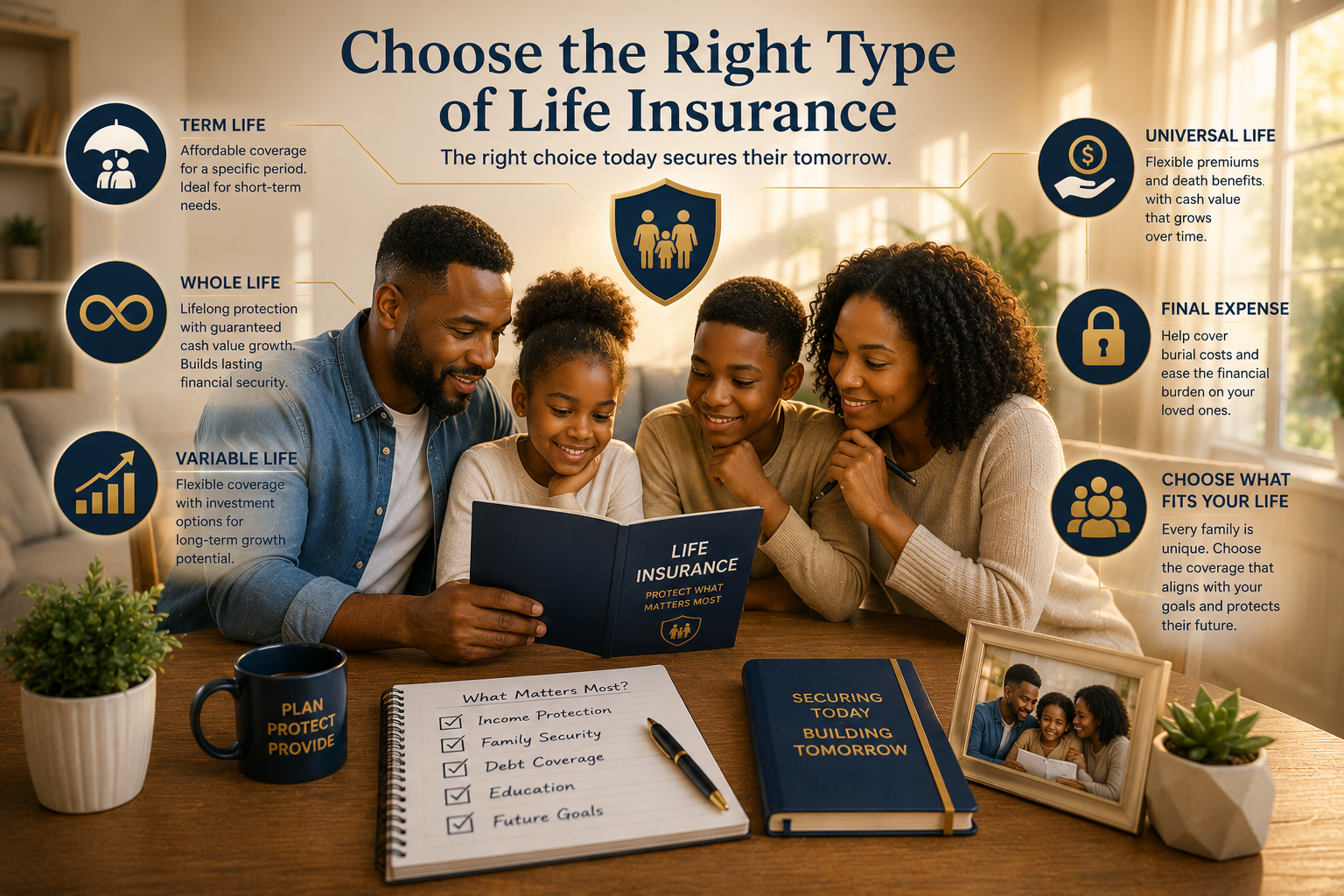
Selecting Life Insurance isn't about choosing the "best" policy.
It's about choosing the right policy for your goals.
Ask yourself:
Who depends on me financially?
How long will protection be needed?
What debts need coverage?
Do I want temporary or lifelong protection?
Is cash-value growth important?
What fits my budget?
Different answers create different strategies.
Life Insurance and Legacy Planning
Legacy extends beyond financial inheritance.
Your legacy includes:
Family security
Opportunities for future generations
Financial stability
Values and planning
The right Life Insurance strategy can support:
Children's futures
Charitable giving
Business succession
Estate preservation
Wealth transfer
Protecting your legacy means preparing thoughtfully—not reactively.
Common Mistakes People Make With Life Insurance
Many people delay important decisions because they assume they have time.
Common mistakes include:
Waiting too long
Age and health affect costs.
Buying insufficient coverage
Underestimating needs creates risk.
Choosing solely on price
Cheaper isn't always better.
Ignoring policy details
Fine print matters.
Failing to review coverage
Needs evolve over time.
Regular reviews help ensure protection remains aligned with life changes.
FAQ
1. What type of Life Insurance is best for most families?
Many families begin with term coverage because it provides affordable protection during major financial years.
2. Is Life Insurance only necessary for parents?
No. Single individuals, business owners, and people with debts or dependents may also benefit.
3. Can I have multiple Life Insurance policies?
Yes. Many individuals layer coverage for different goals.
4. Does employer coverage provide enough protection?
Not always. Workplace coverage may be limited and may not transfer when employment changes.
5. When is the best time to buy Life Insurance?
Generally, earlier purchases may provide lower premiums and broader eligibility.
Final Thoughts
Protecting your legacy is not simply about preparing for the unexpected.
It is about creating security, preserving opportunities, and ensuring the people you care about are supported long after you're gone.
The world of Life Insurance can initially seem complex, but understanding the different options transforms uncertainty into confidence.
Whether you choose Term Life Insurance, Whole Life Insurance, Universal Life Insurance, or another strategy entirely, the goal remains the same:
Protect what matters most.
Because your legacy deserves more than hope.
It deserves a plan.